

Your next product task might be understanding a customer complaint, getting agreement on a proposal, or testing a new service. Each gives you a specific place to put AI to work.
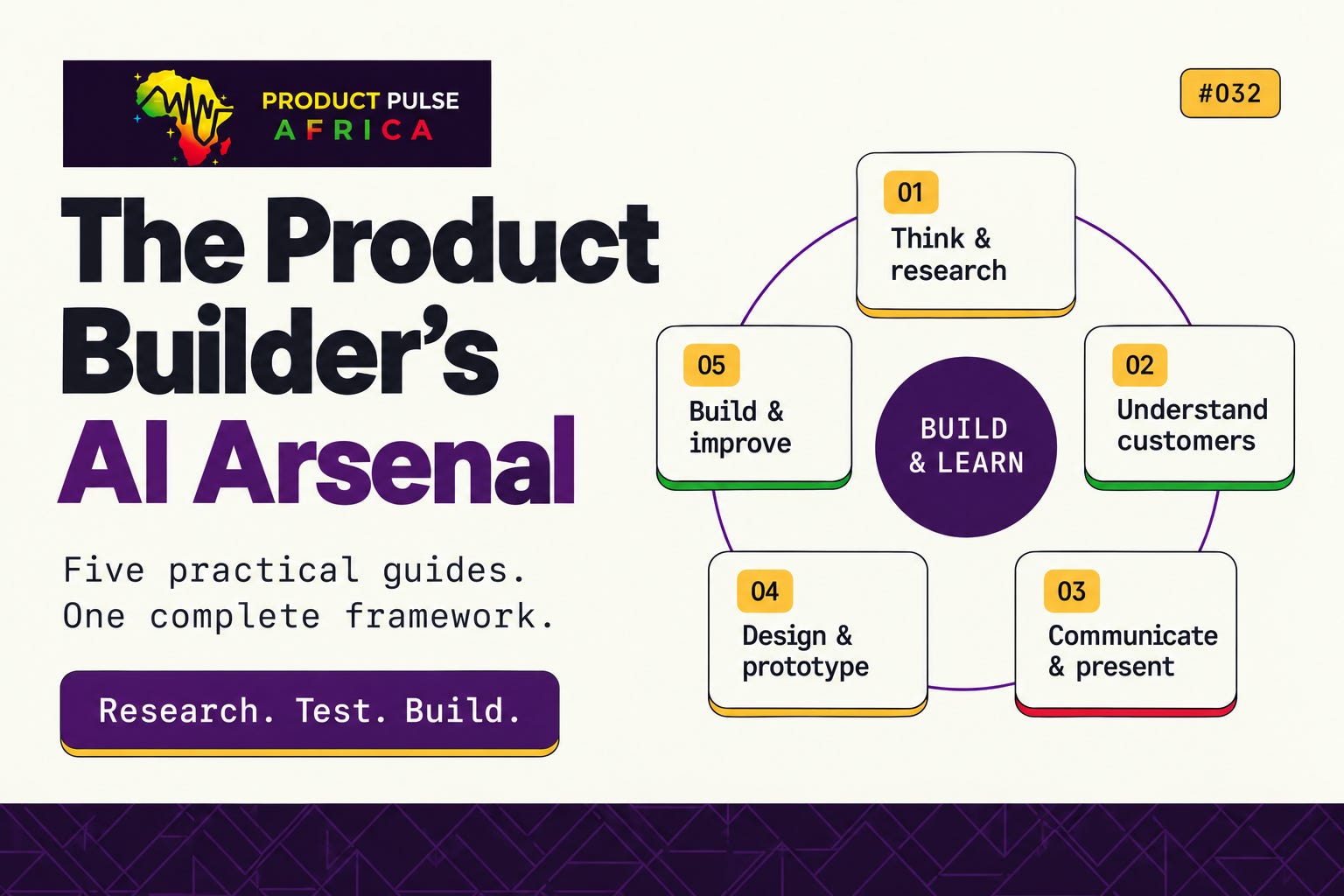
Across the Product Builder’s AI Arsenal, we explored five areas of product work through examples, copyable prompts, and checks for reviewing the result.
This edition brings the series together. If you missed a guide, you can find it below. If you followed along, use this recap to choose something to apply to your next piece of work.
The businesses and scenarios are fictional teaching examples. You can adapt the workflows to your own product, service, or team.
1. Think and research: Work out what needs investigating
Imagine you run a furniture shop in Nairobi. Customers keep asking for cheaper sofas. Your first instinct is to offer a discount.
But the enquiries tell different stories. One customer cannot afford the total. Another thought delivery was included. A third wants to understand why your sofa costs more than a similar-looking alternative.
Those details change what you investigate. A discount reduces the price, but leaves questions about quality or unexpected charges unanswered.
The first guide shows how to give AI a business brief and labelled customer comments. You then examine possible explanations, challenge them, and prepare a one-page decision brief.
You leave with a clearer account of what you know, what remains uncertain, and what to check next.
Work through Part 1: Think and research
2. Capture and understand customers: Keep the meaning in the feedback
“I couldn’t pause my subscription while travelling.”
A meal-subscription customer leaves this comment when cancelling. Before adding a feature to the roadmap, you need to understand what happened. Did they find the control? Did it fail? Had the deadline passed?
Another customer successfully skipped a week. Keep both accounts. The difference could help you identify the conditions behind the problem.
This guide shows how to preserve customer wording, organise related comments, and prepare neutral follow-up questions. Ask AI to retain source references so you can check each interpretation against the original conversation.
For interviews that switch between English and Kiswahili, check ambiguous wording before accepting the summary. A small transcription error can reverse the meaning.
Use Part 2 to organise your next set of customer conversations
3. Communicate and present: Make the decision clear
You have the subscription feedback and a meeting tomorrow. Before asking AI for six slides, write down the decision you need colleagues to make.
In this example, the request is to investigate the pause experience, with agreed owners and a review date.
That gives the presentation a purpose. Support needs to know which customers to contact. Design and engineering need the attempted steps and any errors. The business owner needs to understand the effort involved and what the investigation could resolve.
The third guide helps you structure that proposal, adapt the explanation for each audience, and rehearse the questions it raises. You also check whether a polished headline claims more than the evidence supports.
Use Part 3 to prepare a proposal for your next meeting
4. Design and prototype: Give someone a task to try
A consultant offers three services. Prospective clients read the descriptions, then ask which one they should choose.
Before rebuilding the entire website, test a smaller question: can someone identify an appropriate service and understand how to request a consultation?
The fourth guide takes you through a prototype with service comparisons, details, and a demonstration form. Give a prospective client a realistic task and watch what happens without directing every click.
If they move repeatedly between two packages, ask what distinction they expected. If they submit the form and assume an appointment is confirmed, check the confirmation wording.
You leave with observed behaviour to guide the next change. Completing a demonstration still leaves willingness to pay unresolved.
Follow Part 4 to build and test one customer journey
5. Build, launch and improve: Check the whole service
The consultant’s website displays “Request received.” Now check that the enquiry was saved, the consultant was notified, and the client received a reply.
The final guide follows that journey into live use. In its fictional launch review, eight enquiries arrive, but only five receive a reply within the promised time. Improving the form would leave those three late replies unresolved.
This part covers three practical uses of AI:
Build: Implement the journey and test what happens when submission succeeds or fails.
Improve: Analyse where people stop, then investigate the reasons through customer conversations.
Automate: Connect acknowledgements, notifications, and follow-up reminders, with someone responsible for failures.
Start with a process you can explain. For a small launch, an enquiry log and manual follow-up may be enough. Add automation where repeated work warrants it.
Use Part 5 to review your next launch from enquiry to response
Choose one task for this week
You can enter the framework wherever your work needs attention. A launch problem may send you back to customer conversations. A prototype may reveal that the service itself needs a clearer definition.
Choose one upcoming task, open the relevant guide, and adapt a prompt using material you are authorised to process. Check the output against the evidence or behaviour you expected. Record what helped and what needed correction.
For the wider map and the tools introduced across all five categories, read the original AI Arsenal overview.
Subscribe to Product Pulse Africa for practical guides to applying AI in product work, with examples and prompts you can adapt.
References and further reading
The Product Builder’s AI Arsenal: Original overview — The five categories and the tools introduced across the framework.
Part 1: Think and research — Examine customer evidence, compare explanations, and prepare a decision brief.
Part 2: Capture and understand customers — Preserve customer conversations, check interpretations, and identify questions to investigate.
Part 3: Communicate and present — Turn evidence into a proposal with a clear decision and adapt it for different audiences.
Part 4: Design and prototype — Build a small prototype, observe people attempting a task, and use the findings to guide changes.
Part 5: Build, launch and improve — Implement the customer journey, investigate usage, and automate recurring work.