

What’s in this post:
Most product teams treat staying current as a reading problem. It isn’t. The real constraint is the absence of a system that filters and synthesizes before content reaches you.
Insight Scout is an automated research agent — not a newsletter. It runs every Monday on a schedule, produces a structured briefing, and lands in Substack as a draft without anyone triggering it.
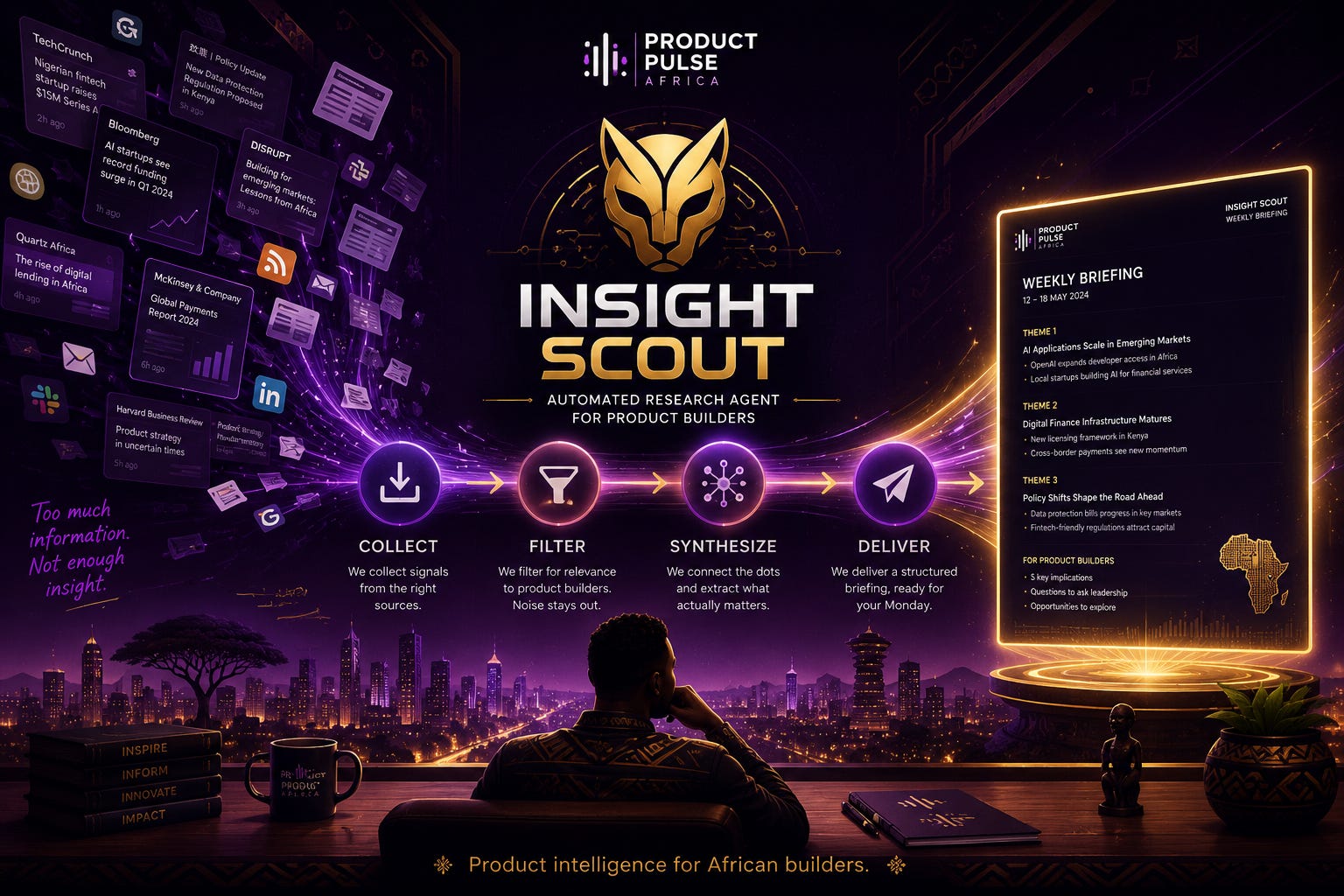
The four-step workflow — Collect, Filter, Synthesize, Deliver — is designed so the agent handles the volume and editorial judgment holds the quality bar.
The filter is the most important step: every story gets scored for relevance to product builders before it reaches the synthesis layer. Low-signal stories are dropped, not passed through.
Built on Replit and powered by GPT-5, with a curated source set covering global tech, emerging markets, business, health, and policy.
If you’re spending hours reading to stay current, you’re solving the wrong problem. There’s a better way to start the week.
The Problem With Reading More
Staying current is not a reading problem. Most product teams treat it like one — more newsletters, broader aggregators, another Slack channel with RSS feeds. The logic is: if I read more, I’ll miss less.
That logic is wrong. Volume is not coverage. Adding more inputs doesn’t reduce noise — it redistributes it, usually closer to your face.
The actual constraint for most product builders isn’t access. It’s the absence of a filter that evaluates relevance before the content reaches them. A PM at a digital lending startup in Nairobi has different signal needs from a PM at a global payments platform. Generic aggregators don’t know the difference and don’t try.
Insight Scout was built to close that gap — to run the research, apply a relevance filter specific to product builders, and produce a structured briefing that’s ready before the week starts. The agent does the reading. Editorial judgment stays with the team.
This is what it is, why we built it, and how it works.
Insight Scout Is a Research Agent, Not a Newsletter
Insight Scout is an automated research agent that runs every Monday, produces a structured weekly briefing for product builders, and lands in the Product Pulse Africa Substack queue as a draft — without anyone triggering it.
Most tools that call themselves intelligence products still require someone to do the reading. They surface content; curation is your problem. Insight Scout inverts that. The agent does the reading, applies a relevance filter, synthesizes across themes, and writes the briefing. What lands in the queue is a structured document — not a link dump, not a headline list.
Picture a head of product at a Nairobi-based digital bank on Monday morning. There are three newsletters, a handful of tech digests, and a WhatsApp thread from a colleague about an article from an African tech publication. They have 15 minutes before standup. They can’t read all of it. They skim, hope they caught what matters, and walk into the meeting carrying half the picture.
With Insight Scout, that same person opens the PPA briefing. Three strategic themes. Five stories with product implications. A set of questions worth raising with leadership. They read it in eight minutes. They walk into standup with a position.
The difference between those two mornings isn’t access — it’s synthesis delivered on a schedule.
The Good Stuff Is Scattered, and Most Aggregators Make It Worse
The information problem for product builders is not that good information doesn’t exist — it’s that extracting it requires the same time and attention it was supposed to save.
Aggregators aggregate. That’s all most of them do. They pull stories into one place and hand the curation problem back to you. The better ones add a human editor, but editorial curation at scale requires staffing, and most publications don’t have the bandwidth to curate specifically for product builders.
The right source set for a product builder spans several different layers. Some publications cover technology in emerging markets with genuine depth — stories that global outlets miss entirely. Others surface African tech developments that rarely travel beyond the continent. Some track the funding and product shifts defining global tech. Others catch practitioner signals that formalize into industry trends months later. Then there are the international business and policy sources that provide the context everything else sits within. None of these alone gives a product builder the full picture. Reading across all of them consistently is a part-time job.
A product manager at a Series B African fintech preparing for quarterly planning wants to know: what regulatory moves, funding patterns, and product shifts are relevant to the roadmap right now? Pulling relevant stories across six publications, filtering by relevance, and synthesizing what they mean collectively takes three to four hours she doesn’t have before the planning doc is due.
Insight Scout runs that process automatically, every week, without waiting for a planning session to force it. The output doesn’t just surface stories — it identifies themes across them.
Curation at the right level of specificity, consistently, without the manual work — that’s what we built for.
Four Steps, One Coordinated System, No Manual Trigger
Insight Scout runs as a scheduled workflow — collect, filter, synthesize, deliver — with each step automated and connected.
Building an agent that reads, evaluates, and writes isn’t complicated in concept. Getting it to run reliably, on a schedule, with consistent output quality, is where most implementations break down. The architecture has to hold across all four steps without supervision.
Step 1 — Collect. The agent wakes up every Monday morning and pulls stories from multiple sources simultaneously. No one starts it. No one points it at the week’s news. It runs.
Step 2 — Filter. Every story gets scored for relevance to product builders. The agent evaluates each one against a set of criteria. Stories that don’t clear the relevance bar are dropped before synthesis begins. This is the step that makes everything else useful — it’s what keeps the briefing focused instead of exhausting.
Step 3 — Synthesize. The surviving stories go through a synthesis layer. The agent doesn’t summarize them individually — it reads across them and identifies what connects, what’s shifting, and what it means for product builders. The output is structured: strategic themes, key stories per theme, product implications, and questions worth raising with leadership.
Step 4 — Deliver. The finished briefing lands in the Product Pulse Africa Substack queue as a draft. It does not auto-publish. We review it, edit if needed, and hit publish. The agent writes. We decide what goes out.
The full cycle — from Monday morning trigger to briefing draft in Substack — runs without a person in the loop. The editorial step is deliberate. Insight Scout can miss context that matters to our readers, and that final review is where it gets caught.
Automation handles the volume. Editorial judgment holds the quality bar.
What It’s Built With
Replit is the foundation. Built, hosted, deployed, and scheduled entirely within the platform — it’s what keeps the whole system running on time every Monday without infrastructure overhead.
GPT-5 is the synthesis layer. It reads the filtered stories and writes the briefing. Remove it and you have a pile of links. With it, you have structured analysis.
Two supporting tools run behind the scenes. One triggers the workflow on schedule without anyone pressing a button. The other stores context between runs so the agent doesn’t start from scratch each Monday.
The sources cover a curated range of global and African publications — spanning technology, business, health, and policy. The selection is intentional: global signal alongside African-originated stories, wide enough to catch what matters, specific enough to stay relevant to practitioners building in this market.
That combination is what keeps the briefing from reading like a generic tech digest.
What This Actually Is
Insight Scout is a functioning research agent — not a prototype, not a concept. It runs every week and produces a briefing that is ready for editorial review before the week starts.
The problem it solves is specific: product builders don’t lack information. They lack a system that extracts signal from noise before it reaches them. Insight Scout is that system.
It’s also the first working product out of Pulse AI Labs — the applied AI arm of Product Pulse Africa. This is how we build: start with a real operational need, build the system, document the process, share what we learn.
The briefing isn’t positioned as a service. It’s positioned as a standard — what product intelligence should actually feel like when it’s built for practitioners, not for general audiences.
The Challenge
Read the next Insight Scout briefing before you open any other news source on Monday morning.
Then run the check: how much of what you read elsewhere that week added to what was already in the briefing — and how much just added volume?
That’s the test. One week. One experiment. The briefing is free.