

Most writing about AI and work begins from the wrong place. It starts with the tools, the speed, or the novelty of what can now be produced in minutes instead of days, and it assumes that the primary problem modern professionals face is inefficiency. If only we could write faster, research faster, summarize faster, and ship faster, then surely the quality of our work would improve as a natural consequence.
But in serious product, strategy, and operational environments, speed is rarely the binding constraint. Judgment is. The difficulty is not generating output. The difficulty is knowing what should be generated, why it should exist, and how it will be defended once it is placed in front of other intelligent, skeptical people.
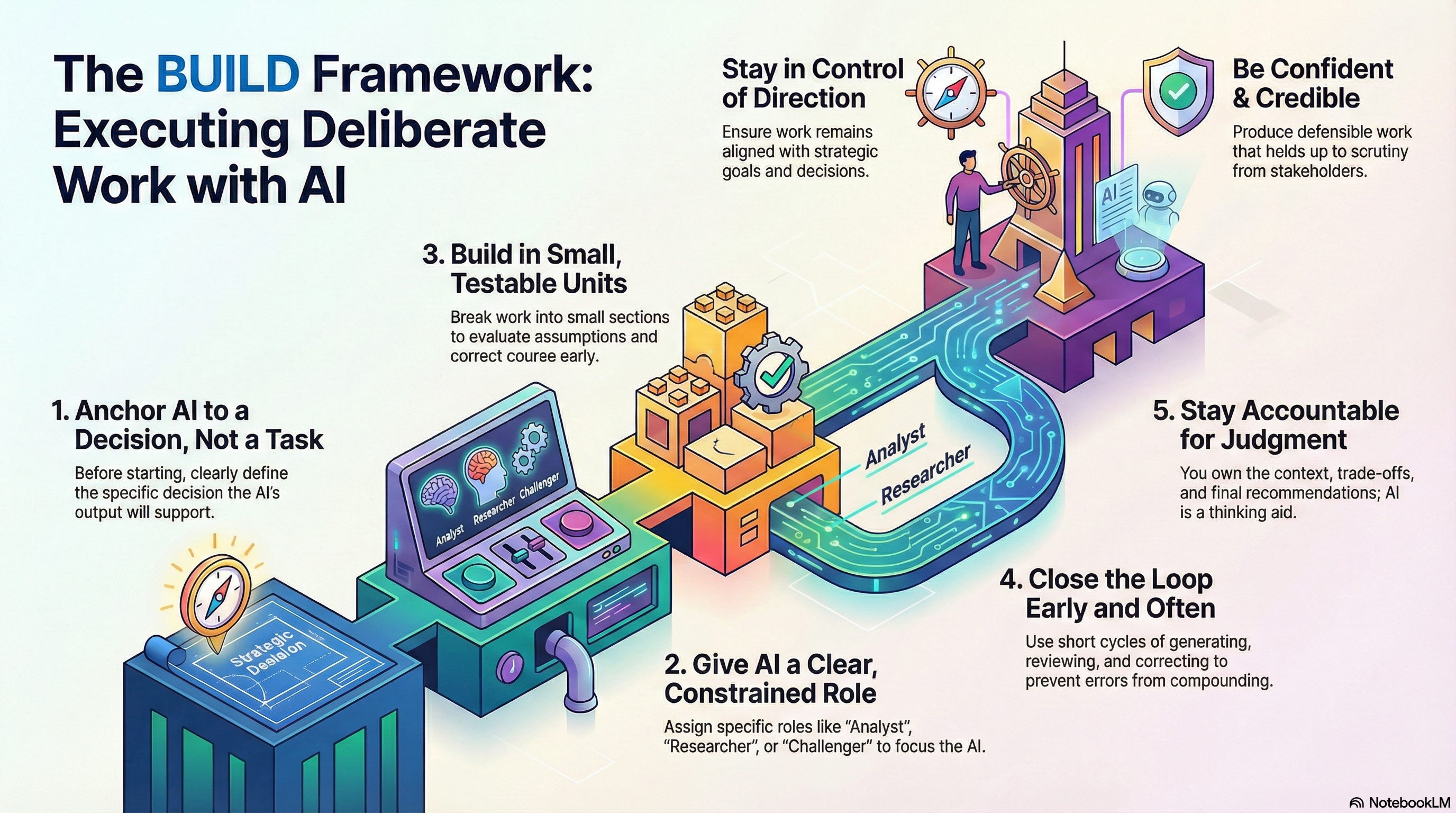
The BUILD framework exists to address this gap. It is an attempt to answer a narrower and more practical question than most AI advice attempts to solve: how can you use AI to accelerate execution without quietly outsourcing the thinking, accountability, and credibility that make the work matter in the first place.
BUILD is not about prompting better, nor is it about learning a clever sequence of instructions that magically produces high-quality artifacts. It is about executing with intention, in a way that preserves human judgment as the central organizing force of the work.
What follows is an explanation of BUILD from first principles, not as a checklist of tactics, but as a way of reasoning about how AI should fit into serious work.
Where BUILD Fits in the Playbook
The Product Pulse AI Playbook is structured around three phases: THINK, BUILD, and PROVE. Each phase exists to solve a different failure mode that appears when AI is introduced into professional environments.
THINK is concerned with orientation. It forces clarity on the problem being addressed, the decision the work is meant to support, and the criteria by which success will be judged. BUILD comes only after that clarity exists. PROVE follows later, once the value of the work must be made visible and defensible to others.
This essay focuses exclusively on BUILD.
By the time you enter the BUILD phase, several things should already be true. You should know which decision this work is meant to inform. You should have a clear sense of what a good outcome looks like in context, not in the abstract. And you should understand the constraints you are operating under, whether they are organizational, technical, political, or temporal.
BUILD does not help you discover these things. It assumes they are already in place. Its purpose is narrower and more demanding: to help you produce work that can survive scrutiny without collapsing under questioning.
The Core Principle of BUILD
At the center of BUILD is a simple idea that is easy to agree with and surprisingly hard to apply in practice: AI should amplify your judgment, not replace it.
Nearly every failure mode in AI-assisted work can be traced back to a violation of this principle. Judgment is ceded when any of the following quietly occur:
AI begins to define the structure of the work rather than respond to it.
Outputs are accepted without pressure-testing or contradiction.
Completeness is mistaken for correctness.
Polish is confused with substance.
BUILD exists as a discipline precisely to prevent this quiet transfer of responsibility. It is not anti-AI. It is anti-unexamined delegation.
The Five BUILD Principles
In its mature form, BUILD is best expressed through five principles. They are not meant to be memorized as slogans, nor are they tied to any particular tool. They describe recurring patterns in how good AI-assisted work is actually produced.
If you remember only one thing, it should be this: BUILD is less about getting AI to do more, and more about placing AI into a role that makes your work stronger.
1. Break Work Into Small, Judgment-Bearing Units
Serious work is rarely a single task. It is a sequence of decisions that build on one another, often implicitly. One of the easiest mistakes to make with AI is to treat these sequences as if they were monolithic, end-to-end problems that can be solved in one pass.
When someone asks an AI system to “write a market analysis,” they are compressing dozens of judgments into a single request. Hidden inside that request are questions such as:
What market boundary is being chosen.
Which assumptions are being surfaced or ignored.
Which trade-offs are being emphasized.
Which uncertainties are being acknowledged and which are being smoothed over.
BUILD begins by making these judgments explicit. The work is decomposed into smaller units, each of which carries a specific decision or assumption. Each unit has a purpose, and each can be evaluated independently.
This matters because senior stakeholders do not really critique documents. They critique the decisions embedded inside them. When work is broken into judgment-bearing units, those decisions become visible, discussable, and defensible.
Once this principle is applied, the role of AI changes. Instead of being asked to “do the work,” it is asked to help explore, test, or articulate parts of the work, while the human remains responsible for how those parts fit together.
The tangible output of this step is not a finished artifact, but a structured outline in which each section exists for a clear reason before AI ever generates a word.
2. Stay Accountable for Judgment
AI is extremely good at generating options. It is extremely bad at owning consequences. This distinction is easy to overlook because the surface-level fluency of AI output can create the illusion of confidence.
BUILD requires that ownership over assumptions, framing, trade-offs, and final recommendations remains explicitly human. A simple test applies here:
If you cannot defend a sentence out loud, without appealing to the fact that “the AI suggested it,” then that sentence does not belong in the work.
Staying accountable for judgment means actively challenging AI-generated claims, asking what is missing rather than only what is present, and rewriting conclusions in your own voice once you have decided what you actually believe.
This discipline matters because credibility accumulates slowly and erodes quickly. One weak or poorly defended recommendation can undermine trust across everything else you produce, regardless of how polished it looks.
When this principle is applied consistently, AI becomes a sparring partner rather than an author. The tangible artifacts of this accountability often appear as annotations, comments, or internal notes that explain why certain choices were made and others were rejected.
3. Give AI a Clear, Constrained Role
The most common way people lose judgment with AI is not through laziness, but through ambiguity. They invite the system into the work without deciding what it is there to do. In that vacuum, AI does what it is optimized to do: it fills space. It produces plausible structure, confident phrasing, and smooth transitions, and it will happily produce an argument even when you have not actually made up your mind.
This is why the missing principle in many AI workflows is role clarity. The question is not whether AI is powerful. The question is what you are permitting it to be.
When AI has a clear constrained role, it becomes useful in ways that feel almost boring, which is a compliment. It becomes a component in your process rather than a substitute for it. It stops behaving like a ghostwriter and starts behaving like an instrument.
A constrained role can take many forms, but it should usually be one of these:
A summarizer of known inputs, with explicit boundaries on what it can and cannot infer.
A generator of alternatives, where you intend to choose rather than accept.
A critic or red team, where you want your reasoning attacked, not affirmed.
A translator between levels of abstraction, for example turning a messy idea into a coherent outline, or turning a coherent outline into a draft.
A pattern finder across notes, feedback, or transcripts, where you want clusters and themes, not conclusions.
Notice what is missing from this list. “Decider” is not a role. “Owner” is not a role. “Authority” is not a role. Those are human responsibilities.
The practical reason this matters is that most stakeholders do not actually mind that you used AI. What they mind is when the work behaves as if no one was responsible for it. If a recommendation cannot be traced back to a person who is willing to stand behind it, the work is politically fragile, even if it looks polished.
Role constraint also gives you a way to design prompts that are not magic spells. If you know the role, you can state the boundaries and outputs clearly. You can say what inputs it must use, what assumptions it must not make, and what format you expect back.
A good constrained-role prompt tends to have four ingredients:
The role and the job to be done.
The allowed inputs.
The prohibited behavior, especially around invention and certainty.
The desired output shape.
You can think of this as the difference between asking someone on your team, “handle this,” and asking them, “draft three options using these sources, highlight uncertainties, and do not make a recommendation.” One request abdicates responsibility. The other creates leverage.
Once you apply this principle, the quality of AI output becomes less important than the quality of the interaction you designed. The tangible output is not just a better paragraph. It is a repeatable workflow where you can predict what AI will do, because you have told it what it is allowed to be.
4. Build in Review Loops, Not One-Shot Outputs
Most people interact with AI in a single pass. They generate an output, skim it, and move on. This works tolerably well for low-stakes tasks, but it fails almost immediately in environments where work will be questioned, debated, or reused.
BUILD assumes that iteration is not optional. A practical review loop is deliberately narrow. A first pass is generated for a single unit of work. That pass is then critiqued against explicit success criteria. Targeted follow-up questions are asked. Only the parts that fail the test are refined.
This approach avoids the common trap of regenerating everything and hoping for improvement through randomness. Instead, it mirrors how strong work is refined even without AI.
The payoff of this discipline is not aesthetic improvement. It is resilience. Work that has been iterated in this way tends to improve under pressure rather than collapse when questioned.
5. Optimize for the Decision, Not the Artifact
The most subtle failure mode in AI-assisted work is optimizing for the artifact instead of the decision it is meant to support. Longer documents, prettier slides, and more comprehensive analyses can all feel like progress while doing very little to clarify what should actually happen next.
BUILD explicitly optimizes for decision quality. Before finalizing anything, it asks a small set of uncomfortable questions:
What decision does this enable?
What question does it answer?
What action should follow once it is read?
If the output does not clearly move a decision forward, it is noise, regardless of how much effort went into producing it.
When this principle is applied, something counterintuitive happens. Less work is produced, but more impact is created. The tangible output is not volume, but clarity in the form of a recommendation, a next step, or a clearly framed choice.
A Practical Example
Consider a product manager preparing a market brief for senior leadership. The real question is not whether the brief is thorough. The real question is whether the organization should invest in a particular segment this year.
Using BUILD, the work is first decomposed into a small number of judgment-bearing units: how the market is defined, which customer pain patterns matter, how competitors are positioned, and where the real investment risks lie.
Before any drafting begins, the role of AI is constrained. It is asked to summarize existing research notes without adding new claims, to generate alternative framings for the segment definition, and to red team the argument by listing the strongest reasons leadership might reject the recommendation.
AI is then used within each unit to surface hypotheses, summarize inputs, or test assumptions, but not to declare conclusions. The human applies judgment by removing generic insights, challenging optimistic narratives, and rewriting conclusions once a position has been formed.
Iteration is applied selectively, focusing attention on the sections most likely to be debated. The final artifact ends not with an impressive amount of information, but with a recommendation, an explicit confidence level, and a clear articulation of the risks leadership should understand.
The result is not flashy. It is useful.
What BUILD Is Not
BUILD is not prompt engineering, tool worship, automation for its own sake, or a shortcut to creativity. It is a working discipline designed for environments where credibility matters.
How to Know BUILD Is Working
When BUILD is applied well, several things tend to happen:
You feel calmer going into reviews because you understand the structure of your own reasoning.
Stakeholders ask sharper questions rather than basic ones.
The work you produce is reused rather than rewritten.
These are quiet signals, but they are reliable.
Closing Thought
AI is not replacing serious work. It is revealing who actually understands it. BUILD is one way of staying on the right side of that divide.
The next phase of the playbook, PROVE, addresses a different problem entirely: not how to do more work, but how to make the value of your work undeniable.
Follow Product Pulse Africa.
Watch the video to learn more about the BUILD framework.
The next phase of the playbook, PROVE, addresses a different problem entirely: not how to do more work, but how to make the value of your work undeniable.
Follow Product Pulse Africa on LinkedIn to learn more and stay tuned.