

AI is no longer optional at work.
Most people reading this are already using it. To write faster. To summarise more. To analyze quickly. To keep up. The tools are accessible. The capability is real. And the pressure to use AI is only increasing.
But something is breaking underneath that progress.
Work is moving faster, yet decisions are not clearer. Output is growing, yet confidence in that output is shrinking. AI appears everywhere in the process, but disappears the moment someone asks, “So what actually changed?”
This is not a skills problem.
It is not a motivation problem.
It is a structure problem.
Most AI advice starts with usage. Which tool to try. Which prompt to copy. Which workflow looks impressive. That skips the most important part of the work and pushes people straight into motion without direction.
Clear thinking before execution.
Intentional building under real constraints.
Proof that the work actually mattered.
I built the Product Pulse AI Playbook to close that gap.
This is not a guide for experimenting with AI.
It is a guide for people who are accountable for outcomes.
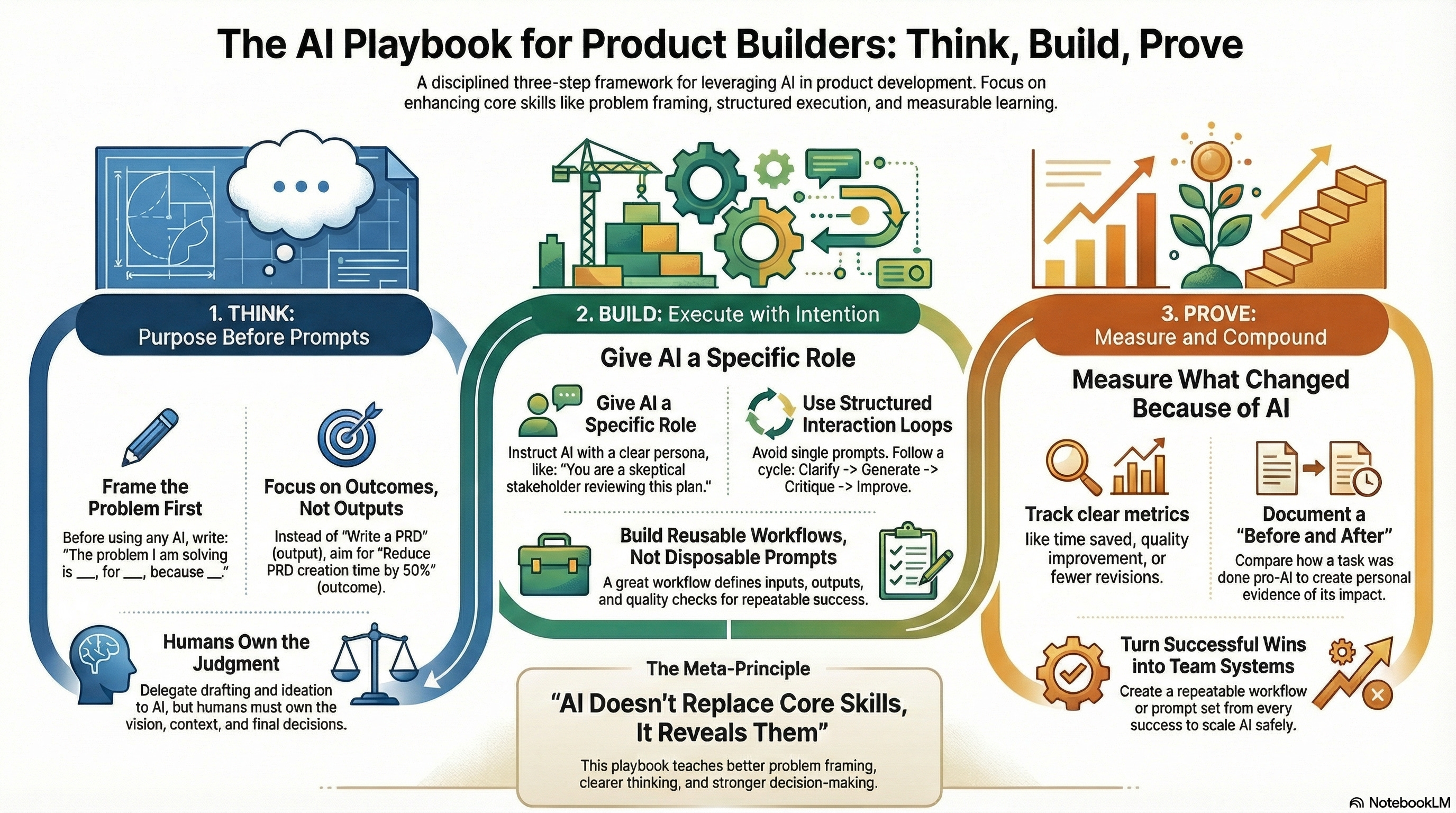
Over the past week, I introduced three pillars that anchor this approach: THINK, BUILD, and PROVE. Not as ideas to admire, but as a practical sequence to follow when the stakes are real and the pressure is on.
It is a working map before we slow things down and go deep on each part.
If you take one thing from this article, let it be this:
AI only creates value at work when it sharpens thinking, strengthens execution, and produces proof that can stand up to scrutiny.
Everything else in this series builds from there.
AI work has three phases
Most AI guidance jumps straight into execution. Open a tool. Ask a question. Generate something that looks useful and move on.
That creates activity. It does not create control.
Strong AI-assisted work follows a clear sequence:
THINK clarifies the real problem and the outcome that matters
BUILD turns intent into disciplined execution
PROVE makes the impact visible and defensible
This is not a framework to memorize or decorate slides with.
It is a practical way of working when time is limited, scrutiny is high, and results matter.
Each phase exists to correct a specific failure that shows up when AI is used without structure.
Why this playbook matters
This is a practical guide for how work is judged now.
AI is changing how work is produced, but more importantly, it is changing how work is evaluated. Faster output is no longer impressive. Using AI is no longer novel. What matters is whether the work holds up when questioned, reviewed, or challenged.
That shift is already happening.
Without a practical way to think, build, and prove work, AI creates surface-level productivity and deep risk. Teams move faster, but alignment weakens. Individuals ship more, but struggle to explain the impact. Decisions feel busy rather than deliberate.
I built this playbook to introduce a shared discipline at a moment when one is urgently needed.
It gives you:
A way to pause before committing to the wrong work
A way to execute with intention instead of experimentation for its own sake
A way to show evidence when speed alone is no longer enough
This is not theory. It is a working guide for people who are expected to explain their decisions and stand behind their output.
AI has raised the bar. I created THINK, BUILD, and PROVE to help your work meet it.
THINK: clarity before speed
THINK is the discipline of orienting the work before execution begins.
It forces uncomfortable but necessary questions to the surface:
What problem are we actually trying to solve?
What decision or outcome does this work need to support?
What would success look like in this specific context?
These questions sound obvious. Under pressure, they are usually skipped.
THINK protects you from:
Solving the wrong problem efficiently
Producing impressive output that leads nowhere
Letting AI define the work instead of the intent
THINK is not overthinking.
It is choosing the right constraints before speed takes over.
When THINK is applied properly, AI becomes a multiplier instead of a distraction. The work that follows is more focused, easier to evaluate, and less likely to be dismissed.
The outputs of THINK are not polished deliverables. They are anchors. Clear problem framing. Explicit assumptions. Defined success criteria.
Next week, we will slow this phase down and go deep into how to THINK with AI deliberately.
BUILD: execution with intention
Clear intent is useless if execution collapses under pressure.
BUILD is where most AI workflows quietly fail. Not because the tool is incapable, but because it is treated like a general helper instead of a collaborator with responsibility.
BUILD is not about collecting tools or perfecting prompts.
It is about structure.
In BUILD, AI is given:
A clear role
Defined constraints
A specific type of output
This is what turns AI from an experiment into a dependable part of real work.
BUILD produces artifacts, not drafts. Work that can be reviewed, challenged, reused, and improved. Work that survives scrutiny instead of collapsing under it.
A future deep dive will focus on how to design repeatable AI workflows that hold up inside real teams.
PROVE: making AI work defensible
This is where credibility is earned or lost.
Many AI-assisted outputs look good. Very few stand up to questioning.
Speed is not proof.
Polish is not proof.
Volume is not proof.
PROVE is the phase that answers the only question that ultimately matters at work:
What changed because of this?
Proof looks like:
A decision that became easier
A trade-off that became visible
A risk that was surfaced earlier
A conversation that shifted direction
PROVE reframes AI from a productivity tool into a decision amplifier. It ensures the work can travel upward, not just sideways.
The final deep dive in this series will focus on how to make AI-assisted work defensible, not just impressive.
How to use this series
This playbook is designed to be used, not admired.
Each week, I will take one phase and unpack it slowly. The goal is not to increase the amount of AI you use, but to enhance the quality and credibility of the work you produce with it.
Before going further, watch the short video below. It recaps the full THINK, BUILD, PROVE system and explains how to approach this series.
Watch the recap here:
As you follow along:
Apply one idea at a time
Notice what changes in your work
Pay attention to what becomes easier to explain
A closing reflection
If someone asked you today:
What did AI actually help you accomplish this week?
What would you point to?
That question sits at the center of this playbook. Everything that follows is designed to help you answer it with confidence. I will be walking through each part of this system in detail in the weeks ahead.